Monday, September 27, 2021

Hollywood 9 to 5 - Episode #6 Writing Audio Description


If you wondered what I thought I'd say, here it is.


Audio Description:

Job:

Today I’m going to talk about writing audio description. This is something required since 2010 for a set number of hours of broadcast material on the major networks. Meaning that lots of TV shows and movies have to include AD whether they want to or not. Details of the law can be found by searching for the 21 Century Communications and Video Accessibility Act (CVAA).

Since this is required by law and not something TV shows and movies elect to do, it often has very low budgets and the quality standards can vary. Some larger companies will include AD in their budgets as an incentive to get more higher paying work from clients. So like if you hire us to do all of the dubbing and subtitling, we’ll throw in AD on your project for practically nothing.

What is it?

AD is a spoken track on a TV show or movie which provides audible information to explain action for visually impaired consumers. Just like with closed captions for hearing impaired, there is another track you can access on your TV which will play the AD alongside the original program. Since this hasn’t been a requirement for very long, there are still some variations in how companies approach the writing of the AD.

Basically, you go through a TV show or movie and create placeholders between the dialogue where a narrator will have time to talk. Then you go back through and put in descriptions of the action in these gaps between dialogue and sound effects. After you write the AD, you need to go back through and actually speak the words, since it doesn’t really matter how great your writing is if no one could reasonably say it in the time allowed. Because you have to speak out loud, or at least mumble the words quietly, this can be annoying to your coworkers if you are in an office and not working from home, but there’s no way around it.

Example:

Here’s a brief audio description of some video shot around my house.

Orange feral cat Trapper and grey tuxedo feral cat O’Keefe sit on a table chomping on cat treats. House cat Hot Lips plays with a rock on the ground and then scratches herself. A pink hibiscus flower sways in a gentle breeze.

Qualifications:

The companies I know that do this work are looking for writers - meaning they are looking for people who identify as “writers” and they are probably actively hiring right now. Since I haven’t been on the hiring end of this, I’m not sure how they determine someone’s writing skills. Also, since the written document is eventually going to be read, I would imagine they wouldn’t be sticklers for things like exactly correct grammar which are needed in some of the other English jobs, like DL and SL creation. And since this is targeted to native English speakers and not going to be translated, there is more leeway on writing informally and using slang terms than there would be in documents given to translators.

Tests and Training:

I trained to do this for one company. They required 4 days of tests, including reading of guidelines documents and watching examples. Since the four days didn’t have to be sequential and you had to wait for feedback after each day of testing, for me this spanned about a month of going back and forth to get ready to be hired for my first project.

I was recommended to the head of that department by a former coworker, but I imagine you can find job listings for AD writers and just apply.

The pay:

So. I did one episode of one TV show - still as sort of a test, but this time I was getting paid and then getting feedback on my work. For me, the pay was atrocious. It didn’t even matter how good or bad my work was, there is no way for that pay rate that I could justify accepting a second episode. This was pre-pandemic, but I think even with the loss of steady work during the pandemic, I couldn’t afford to do this.

Part of me feels like I let the company down or left them thinking I couldn’t handle the notes or adapt my writing style, when really I just couldn’t do this and afford to feed myself and my cats. If that was my only choice of work, I’d go back to answering phones at a temp job, pretty much anything else I could figure out.

Now, I’m not saying this will be the same experience for everyone. If you can afford to get through the training - for no money - and can hold out with the extremely low-paying work long enough to get really fast at writing the AD, this might be a good job for you. As with all freelance jobs, you are paid for the project and not based on how long it takes you to do. If you can devote a whole week to making $200 for several months at a time, you might be able to eventually get your speed up to the point where you can do that amount of work in a day instead of a week, even though there might not be enough work to then keep you busy for the whole week. At least it won’t be a tremendous waste of your time. Or, if you can get a staff job writing AD it might work out better where you would then be paid hourly.

This section (underlined) didn’t make it to the video: I’m going to go on a little tangent now, though. In California, there was a law called AB5 which went into effect in 2019 which has really messed up a lot of freelance work vs. full-time work. The law was meant to target companies like Uber and Lyft, to force them to give better pay and benefits to drivers, but it has ruined the lives of many other freelancers. It left a lot of companies with two choices about freelancers - either everyone who does a certain job, like writing AD, needs to be freelance, or they all have to be staff with no freelancers doing that job. Or, maybe, if there are a few staff people they can hire freelancers as long as the freelancers don’t reside in California. So I’m not sure if there are many staff writing jobs for AD left and if there are, they might be limited to part-time only. I really don’t know, I just know that AB5 has not helped anyone.

So, my advice, if you can find a full-time staff job doing this, it might be worth it. Otherwise, it is a lot of work and training for, at least in the beginning, a non-living wage.

Downsides:

The downside for me was the pay. Just not worth it for me to do more than the one job. I should have asked the pay during my training time, but didn’t and got stuck having to do a job that made me feel cheap and unappreciated.

This section (underlined) didn’t make it to the video: And, I just have to add this rant, one of the notes repeated during training was to not use the verb “to be.” If you’ve taken a screenwriting class, you know this usually means “don’t write in passive voice, avoid verbs ending in -ing.” This turned out to not be what they meant. The person who proofread (and changed every line I wrote) on my one and only assignment, added lots of words which ended in “-ing,” but literally didn’t put the “to be” conjugation with them. So instead of saying something like “The rabbit is jumping and grooming its ears,” it would say “Jumping, the rabbit grooms its ears.” I found this note to be contradictory and it really bothered me. I will always have a problem with this and hold a grudge.

Wrap up:

So, AD writing is out there, and because it’s the law, it will continue to be out there. And it might be something you would excel at, it just wasn’t a fast enough fit for me for the money.

If you have any questions, please feel free to ask them below. Don’t forget to subscribe so you can see all my videos and learn more about what people in Los Angeles who aren’t rich and famous do.

Sunday, September 19, 2021

Hollywood 9 to 5 - episode #5 Writing Creative Letters

 Here's the latest video on writing Creative Letters. Below the video, I'll post the script I wrote if you want the highlights without watching the video or if you want to see how different the actual video turned out from what I thought I was going to say.


Creative Letter Writing

Hi. I just wanted to start by saying that if you notice I’ve been a while between posts, I will often put something on my community page to let you know what’s been going on with me and why I haven’t been posting much.

 Job Description:

Today I’m going to talk about writing something called a “creative letter.” This is another job in the International Versioning Department, and is used for dubbing.

The name is a little bit misleading. When you write a creative letter, you aren’t being very creative. You’re writing a technical document which assists in the casting of voice actors in foreign countries for the dubbed versions of the film.

A creative letter is an aggregate of a lot of information taken from the dialogue lists which have already been created with the addition of other items. If you are hired to write a creative letter, you should request a previous one to use as a template of how that client wants the information presented, so you aren’t starting from scratch.

The creative letter will include some basic information about the film - like how long it is, the main cast from the end credits, and links to the IMDb page and any official sites for the movie. There might also be some technical information, but that will be supplied by the client - like how they want the dubbed files returned to them and what casting approval might need to happen before voice actors are hired.

The most creative part the creative letter writer needs to write is a synopsis of the film. On some projects, this can be surprisingly difficult. The synopsis doesn’t need to go into all of the details of a movie, but it should cover important plot and character points. A synopsis can range between one paragraph and two pages.

 After that, the creative letter is divided into sections which include things like a list of the characters in a movie, the actor playing them, the actor’s credits, the actor’s age and the character’s age and then a description of the character and a description of the character’s voice.

The most difficult part of creative letter writing is describing the vocal qualities of the character. The description needs to include those vocal qualities which have to do with the character and differentiate them from the vocal qualities inherent in the actor.

For instance, is it important that a female character has a deep voice? Is she mistaken for a man over the phone? Or is it just that Emma Stone is the actress and she happens to have a deep voice?

So in a role like Emma Stone in Cruella, the creative letter would include a note that when Estella is acting like Cruella she intentionally lowers the tone of her voice, as if they are two different people. You wouldn’t necessarily need to note that Estella has a deep voice, but rather that there is a tonal change when she is in one persona or the other.

These character and voice descriptions are written for each character thought of as a “main” character. Sometimes that means even if a character only appears for five minutes, they need to have a section dedicated to them. Other times, a character who appears more frequently might be a side character and not require this information. The client can help guide the writer about which characters they expect to get this detailed treatment.

The CL then goes on to include word counts of how many words each character speaks - so the dubbing supervisor can estimate how long to book each actor into the dubbing studio. Every character who speaks in a movie will be included in the word count list, whether they speak 2000 words or just grunt one time.

The creative letter will also then include a section detailing any words or phrases which require special attention when the move it translated and dubbed. This might be something like a catch phrase that needs to be said the same way each time a character says it, or it could be alliterations which should be preserved during the translation. This is up to the discretion of the CL writer, although the client will often weigh in if they feel something has been overlooked.

The CL will also include a list of all of the on-screen text in a movie, because some territories might decide to have a character say the text rather than putting up a written translation of it. Like if someone is reading a letter and in the OV it is just shown as the letter, it might be read in a dubbed version instead of having text added to the picture.

There will be a list of songs and something called “ditties” which will have specific instructions from the client. Often if a song is by someone famous, that person has agreed to sing the song with the understanding it will not be replaced in the foreign dubs. So if someone like Selena Gomez stars in a movie and sings, you might have permission to dub all of her speaking but be contractually obligated to subtitle when she sings, leaving her voice and vocal performance in. This is information the client will give you but it needs to be in the creative letter.

A ditty is a song which doesn’t require full lead sheets. Maybe someone improvised something sing-songy and it doesn’t matter if the person dubbing it sings the same notes or key or anything, just that they sing those words or lines.

 That’s the basics of what goes into it.

 Example:

Let me put up a little example of what some pages of a creative letter might look like.

 Qualifications:

The best creative letter writings I’ve worked with are professional singers. They are more in tune with hearing different vocal qualities and describing them. You don’t have to be a professional singer, but you need to have a good ear.

Tests:

We didn’t test anyone in this job.

Training:

As far as training goes, it seems like there are two paths to learning this. If you find someone who writes creative letters, you can try to offer to help them out in exchange for them teaching you how to write one, or if you are in an English Department and have the opportunity to proofread CLs, if you are self-directed in your learning ability, you can figure out how to write them and then offer your services to the department.

The pay:

This is definitely a freelance thing and not enough money to pay your bills like a full-time job. Think of it as an enhancement. The CL writers I’ve known were also something else, like a dubbing supervisor, voice teacher or a loop group lead. Or they might be a member of the English department who gets to do this in addition to other things, like DL and SL creation. On the plus side, you will sometimes luck out with a very easy assignment.

There are sort of three categories of jobs.

The first is short things, like a trailer, TV spot or Interstitial will all pay the same. An interstitial would be something short which appears like on commercial bumpers or DVD bonus feature, so if you get an interstitial which has one line, you will get a good payday.

Then there are short films. They require almost as much work as a feature or TV show, because they will have a full run of characters. For instance, there are a few short films based on the characters from Frozen and Tangled. Luckily, the features were already done so a lot of information could be reused from those CLs, but had they not been done already, the labor involved in creating the CL would have been similar to a feature, for less pay.

And then there are features and TV series. Features and TV series pay better, but they require more work and have tight deadlines.

Features will also usually require a first version, for higher pay, and then revisions when new versions of the edit are done. The revisions are usually pretty easy and mostly just require updating word counts and text lists, since it is rare that new characters would be added between edits of a film, but they will have a very fast turnaround, of like one or two days.

TV series are usually very involved for the first episode, but after that the dialogue list editors will probably handle making any updates themselves, so the CL writer will not be hired for more than the first episode and maybe a few updates as characters are added or removed from the series.

I asked my friend who wrote CLs for a long time what she liked best about the work and here’s what she said.

1. Got to see new movies early

2. I found the input pleasant.

3. It allows you to use your ears, and training to describe voices, i.e. pitch, timbre, intent.

4. the Synopses were hard, but taught me to be a better writer.

5. I liked working with my boss!!!!

Downsides:

I didn't like to intense deadlines. I didn't like picky (client).  It got hard having to do all the subtitles as well.  I didn't like the grind, but LOVED the money!

Wrap up:

So, writing CLs is something you might be interested in adding to your arsenal of skills, but don’t expect this to be your exclusive full-time job. I don’t know of any companies that have someone on staff who just writes creative letters.

 If you have any questions, please feel free to ask them below. Don’t forget to subscribe so you can see all my videos and learn more about what people in Los Angeles who aren’t rich and famous do.


Saturday, September 11, 2021

MAC 2021 Lunar New Year Lipstick Collection and Beauty Blog Rant

 Ross currently has MAC lipsticks which were part of the special-edition release for Lunar New Year 2021. I don’t know how your Ross handles cosmetics, but here’s what mine does… They used to keep them in the jewelry counter, but I guess that got to be a little annoying for employees, so they started putting them in locked clear boxes. You can see what they have and what it costs, but for things like lipstick, which is in an opaque box, you might not have any clue what the color actually is. At least this gives you confidence as a buyer that no one has tried on the makeup or accidentally left the lipstick extended while putting the cap back on. I guess maybe you can ask someone who works at the store to open the box so you can check the colors, but if you’re like me, you don’t want any interaction with people while you are out, even if it saves you some trouble and money by having a better idea of what you might buy.

 But this is the modern age! I saw these lipsticks and knew I was interested in them and took out my phone. Surely I should be able to quickly determine what colors they were by searching through beauty blogs. Surely…

 A few videos popped up at the top of the search, but I didn’t want to start watching potentially long-winded vlogs in the middle of Ross. The information I needed was just a list of color names, a picture of the color and maybe a description of the color to help me assess how good the pictures/my phone screen were representing things. A few blogs popped up, but they were so overrun with ads and pop-ups I struggled to even find if they really were about the lipstick I was looking at. Seriously, I understand wanting to make money from a blog, but at the point where you have an ad for every sentence or picture, you’ve lost readers and are NOT HELPFUL!

 One blog, which had the most useful information (which I only found after leaving the store and searching again when I wasn’t pressed for time) looks like it was Google translated from another language. The names of the lipsticks are all slightly off, but since I did do a blind buy on two of the lipsticks on my first outing, I could confirm that they were sort of accurate in their descriptions with a fairly simple puzzle of what the names of the colors were.


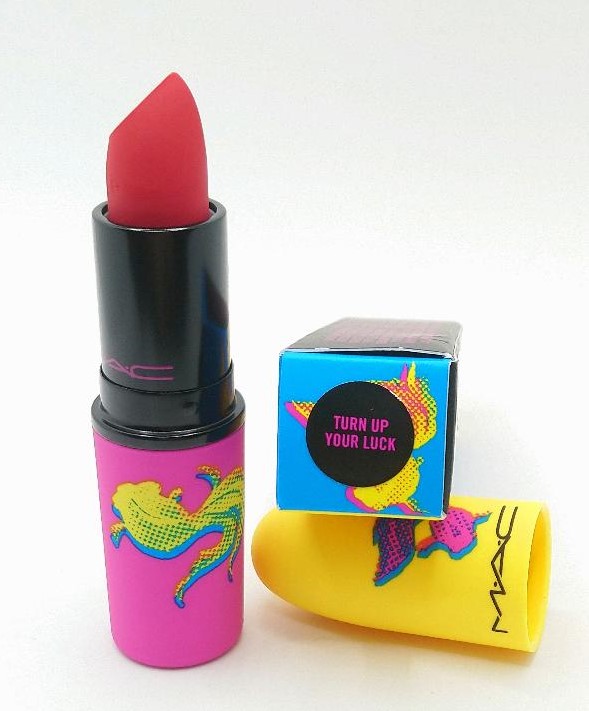
Turn Up Your Luck was listed as “Turn Up Your Rack,” a vibrant bright red.

Luck Be a Lady was listed as “Luck Bee Lady,” a smoky brown red.

Brickthrough was correct, but spelled as two words, a dusty rose.

Healthy, Wealthy and Thriving was listed at “Healthy, Wealthy and Sliving,” a true red.

And Playing Koi was mistranslated as “Playing Carp,” losing the pun in the name, a vibrant orange coral.


Despite all the words I’ve used to express my dismay at how bad beauty blogs are, my thought here was to present a better version of the beauty blog about these lipsticks. Starting now.

MAC Cosmetics has released a limited edition set of colors for 2021 Lunar New Year. Packaged in vibrant boxes with graphics of goldfish on the colorful tubes, the lipsticks are available in five colors in the “powder kiss lipstick” formulation. The packages on all of the colors are identical.


Brickthrough is a dusty pink:


Healthy, Wealthy and Thriving is a traditional blue-red:


Luck Be a Lady is a brownish red:


Playing Koi is a bright orange coral:


Turn Up Your Luck is a bright pink-red. (I’m listing them in alphabetical order and they appear in this order in the pictures.)


The powder kiss lipstick formulation has a sweetener in it, so when you lick your lips you get a rush of sugar. They are also infused with a sugary vanilla fragrance. They glide on smooth and are weightless to wear. The color intensity deepens as you swipe back over your lips each time. Here I’ve swiped the colors on my arm. Each one has been applied twice - once lightly and once going back over it several times - so you can see how they darken with repeat application.


For my personal preference, I’ll be wearing Brickthrough the most, as a solid everyday color. I’ll wear Luck Be a Lady the second most, when I want something a little more intense, although the brown in it does lean a little bit to the orange side. For some reason, when I allow the girls at cosmetics counters to put makeup on me, putting me in an orange coral color is their favorite thing to do, but I’m unlikely to wear the orange/coral Playing Koi. I’m also unlikely to wear Turn Up Your Luck, since it is just a little too bright pink for me. Healthy, Wealthy and Thriving is a solid blue-red. For those out there who like a red lip, I think it is a winner. Maybe if the pandemic ever gets under control enough that I go out again, I’ll wear Healthy, Wealthy and Thriving for that extra drama of a red lip.


MAC no longer carries these limited-edition lipsticks, but you can currently (September 2021) find them at some Ross stores, and I’m sure you’ll be able to find them on websites like eBay for a while.

Thursday, September 9, 2021

The Murder of Roger Ackroyd by Agatha Christie - September Book Report

 If there’s one thing I love, it’s a cozy mystery -- British preferred. I have seen every episode of Murder, She Wrote several times. I can watch Columbo episodes again and again. Agatha Raisin? Loved it. I’ve seen all of Poirot, Father Brown, Miss Fisher, Shakespeare & Hathaway, Rosemary & Thyme, Queens of Mystery and others. Not all of them work for me, but many do. So for my next book, I decided to not go for another memoir but to try a mystery novel instead.

The Murder of Roger Ackroyd is a Poirot story by Agatha Christie, published in 1926. I got the audiobook version, read by Hugh Fraser, who happens to play Captain Hastings on Poirot. He did a terrific job of reading/performing this story, including doing a good Poirot voice.

A couple of things stuck out to me in this novel. First, I must have read it before. Actually read it. I knew who the murderer was almost immediately. I’ve only read maybe three Agatha Christie novels, millions of years ago, so I thought it would be unlikely that I would select an audiobook of one of those that I’ve read, but that’s what happened.

If you’ve ever read any Agatha Christie, then you will know that guessing the murderer is nearly impossible. She withholds vital information until the very end, or introduces a new character at the very end. One of my favorite movies, Murder by Death, has a speech near the end about the frustration of reading stories by a writer like Christie. I found a copy of the speech online, which might not be accurate, but you get the point:

“You've tricked and fooled your readers for years. You've tortured us all with surprise endings that made no sense. You've introduced characters in the last five pages that were never in the book before. You've withheld clues and information that made it impossible for us to guess who did it. But now, the tables are turned. Millions of angry mystery readers are now getting their revenge. When the world learns I've outsmarted you, they'll be selling your $1.95 books for twelve cents.” -- Lionel Twain

That sums up my experience. So when I watch an episode of Poirot or Marple, I don’t try to figure out who did it. That is an impossible task. I just enjoy seeing the detective at work. Christie is a good writer and reading or listening to her work is enjoyable.

The second thing that stuck out to me was how easy her stories are to adapt to TVs and movies, which is probably why they remain so popular. The novel sounded almost like someone reading a screenplay. The dialogue was complete. The characters were complete. The locations were visual and the story was engaging.

I tried to find the TV version of this story, but for some reason it isn’t available on the subscription services I have, and I don’t want to pay extra just to watch it. Maybe I’ll change my mind, but for now that’s where I’m at.

Overall, this was a great title to listen to while pulling up crabgrass in my yard, and I’m leaving the door open to listening to more stories written by Agatha Christie.


Saturday, August 21, 2021

Gina Yashere: Cack-Handed: A Memoir - August (Audio) Book Report

The past few months I’ve been listening to a lot of the podcase RHLSP (Richard Herring’s Leicester Square Theater Podcast), where comedian Richard Herring interviews other (mainly British) comedians. Part of the appeal of that podcast is how terrible Richard Herring is at interviewing people. Another part of the appeal is that a lot of the episodes have video with them, not just audio, and can be watched on YouTube. A few of the interviews I’ve watched have been Stephen Fry, David Mitchell, David Baddiel, John Oliver, Alex Horne, Robert Webb. All men. All very successful in comedy. All graduates of Cambridge.

Looking at the list of Cambridge graduates you will also find Richard Ayoade, Jimmy Carr, John Cleese, Eric Idle, Peter Cook, Hugh Dennis, Simon Bird, Hugh Laurie, Mel Giedroyc, Sue Perkins, Ian McKellen, Emma Thompson, Sandi Toksvig, Olivia Colman and Sacha Baron Cohen. It seems like if you want to get into TV comedy in England, the fastest way to do it is by attending Cambridge and joining Footlights. Privilege and money seem like a shortcut to success.

After hearing so many of these identical stories, I was looking for something different. Didn’t anyone struggle? Didn’t anyone have to really claw their way up based only on their talent and not their luck? Sure, these people don’t have perfect lives, but not everyone starts at the same place. The Cambridge people started ahead and it isn’t too surprising they stayed ahead and will finish ahead.

Gina Yashere started behind. Her parents were from Nigeria and there was no free ride. As soon as she started working, in her mid-teens, she had to start giving part of her income to her mother (her father was gone by then) to help with the household expenses. Her mother hustled to keep the family together and to provide the best she could for her kids. And part of that meant her kids were going to be professionals.

Gina Yashere was slated to be the doctor in the family, but dissecting a frog ended that dream. She had to pass the doctor job onto a younger brother and became an engineer instead. But her heart wasn’t in it. A fortunate turn of events with work, leading to a few months of no work but with pay, allowed Gina to explore her creative side and that’s all it took for her to not go back to being an engineer.

Her memoir, Cack-Handed: A Memoir, tells the story of her life and how difficult it was to break into comedy in the UK. The racism and exclusion she experienced there led her to move to the USA where she has become a success with the TV series she writes and stars in, Bob Abishola.

But that’s the happy ending, where she is now. The book is about how she got there. An abusive step-father, a half-hearted suicide attempt, fights at school, moving around a lot, and being the outsider.

The chapter headings are all based on Nigerian sayings, and they are a delight. Here are a few:

A snake can only give birth to long things.
Going to church doesn’t make you a holy person any more than going to a garage makes you a mechanic.
If you sleep with an itching anus, you will definitely wake up with your hand smelling.
However hard a lizard does a push-up, it will never have an alligator’s chest.

It was a refreshing change to hear the story of someone normal, without the access and connections of a white man from a good family, who was able to make their dreams come true. Gina shows the outcomes that are possible through hard work, talent, determination and never questioning your own worth.

If you don’t know who Gina Yashere is, there are lots of clips of her on YouTube and as of this writing, two of her stand-up specials are available to stream on Netflix.


Thursday, July 29, 2021

Hollywood 9 to 5 - episode #4 Writing Continuity

Here's the video:


And here's what I thought I was going to say:

Job Description: Today I’m going to talk about writing continuity. This is the job I currently have!

If you work in an English department, this might be part of your job, but most companies like to hire freelancers to do this. Even if you don’t have to write the continuity itself, you will still need to know what it is. You will probably have to assemble a CCSL (combined continuity and spotting list) at some point. Most English departments hire outside freelancers for the continuity writing because it is time consuming and the members of the team will have other tasks which are more pressing with tighter deadlines.

I use the job title “continuity writer.”

 What is continuity?

Continuity is a shot-by-shot description of the complete action of a movie. Occasionally a trailer will also require continuity. And yes, every shot. Most movies average around fifteen hundred shots, but I’ve worked on a few movies which have had over 4000 shots and some with under 500 shots. It just depends on the editing style and genre. Action movies, superhero movies and some comedies will have higher shot counts while dramas and actual horror films, not slasher, but like suspenseful horror films, will be on the lower end of shot counts. Although you never know for sure.

Though the continuity focuses on the main action, it will include any text which appears on screen, including details about signs even if they are in the background and more atmospheric than something the viewer needs to read, as well as including descriptions of action in the background or information about new locations to help set the scene. Once background action is described, it can be left out of subsequent entries in the same scene so that the entries can just focus on main action.

Since the continuity will be placed with the dialogue and spotting lists, no mention of dialogue gets included in it. You might occasionally include notes about sounds, like if a doorbell rings or something, but in general you could write the continuity with the picture muted and still include the majority of what needs to go into the it, because it’s just based on what you can see.

Why continuity: The CCSL document gets sent to the library of congress as part of the official paper record of a film. It can also get sent to some territories where the translator technologically can’t access the film as easily as some other places. So the translator can read the CCSL and have a more complete understanding of the film than they would otherwise have just from the dialogue list or spotting list with annotations if they can’t easily access picture.

On independent films, they might not even know why they are writing a CCSL with continuity, they will just have been told it is a “delivery requirement,” meaning that a larger company will not consider buying the small film unless this document has already been created and paid for by the original production company. Usually, these are not as thorough as one created by an English department.

Example: Here’s an example of some continuity I’ve written for a short documentary a friend and I have been working on. Usually the client will provide a list of shot in-times, which can then just be spot checked while working, so you are only responsible for the writing part.

Or, here’s a sample of some continuity I’ve written for some shots around my house.

For the actual writing part, the entries contain a screenplay-like slug line each time the location changes. The slug line includes whether the scene takes place inside or outside (INT. or EXT.), where the location is, usually from large to small. Like a scene of me sitting here might start with INT. Tujunga / Camille’s House / Main Room. Then the slug line includes a general term for time of day, usually either day or night, although dusk and dawn are sometimes used if it is important to the plot. Then normally the shot framing is given- which is a description of how close to the subject of the shot the camera is, I’ll explain a little bit more about this later -  and finally a description is written about what action happens in the scene. It could be as short as MCS - Camille, or more involved, like MCS - Camille. She sits in front of a scarf-draped piano which has vases of flowers and various knickknacks on it.

Then repeat with the next shot until you reach the end of the movie.

If you’ve seen Avengers: Age of Ultron, imagine the big fight scene near the end when all of the Ultron drones fight with the Avengers. That’s what continuity writing can feel like. You are an Avenger fighting a seemingly never-ending parade of killer robots. And working on that movie gave me one of my mottos for continuity writing which is “fight the robot in front of you.” You can’t spend your time thinking about how many shots there are still to write in a movie. It becomes overwhelming. You just write one entry at a time, chugging along, until eventually you will reach the end.

Qualifications and Tests: Just like with other jobs in or for an English department, you will probably have to take some kind of English test, although if you worked with one company as a freelancer and someone from that company moves to a new company, you might not have to take the tests and will get the work just based on your work history and past relationship.

I’ve never had to take a test specific to continuity writing. If there is a test, it will be the same general English proficiency test used for the rest of the English department.

Training: As with most things, you are unlikely to get a lot of training. You’ll will be given an example document, mostly for formatting, and probably there will be some kind of guidelines document detailing how to write continuity. I have written some of these guidelines documents and always include a page with stick figures to show what different shot framings look like for my preference.

At the first company I worked for in Hollywood, which was literally in Hollywood, I spent one Christmas span writing continuity on an independent film called Palmer’s Pick-Up. This was in the before times when digital storage was outrageously expensive and 2-gig drives were the size of shoeboxes, so I had to use a ¾ inch u-matic machine to play the video, with a TV monitor attached and then write the continuity, inputting time codes by hand, on a computer in Word. I don’t think I ended up doing the whole movie, just as much as I could get done as the only person in the office during that slow time of year.

What kind of person is this good for: The hardest part of the job is that it is repetitive and tedious. If you are the kind of person who likes to do intricate hobbies, like beading or painting, or assembling jigsaw puzzles, you are starting off with a good temperament for it. When I worked in an English department and hired the freelancers to write the continuity, it wasn’t uncommon to have people get hired for one or two projects and decide it wasn’t for them.

The reason I learned how to write continuity for real was that our freelancer (Hi, John!) decided he had had enough of continuity writing. We didn’t have another person lined up who could take over, so I jumped in. The first project I did in this more professional capacity was Shark Boy and Lava Girl, and I put in way too much detail, which John then had to proofread and critique. It can take a while to figure out just how much detail to include and when it is too much and really distracting from the important information of the scene. So there is a little bit of a learning curve to figure out how much is the right amount of detail to include.

The downsides: The biggest downside is how tedious this is. If you can get past that, then the next obstacle you might encounter is the turnaround time. If you are very slow at this, or just can’t handle doing maybe 500 or more shots in a day, then you could run into trouble with the deadlines. Usually there is at least one day per reel on a project. A trailer, which is short, but probably 200 shots, will also have about a day turnaround time. On some projects, that might not be enough time. Animation is particularly difficult and time-consuming, so extra time on animated features is always welcome. I recently finished an animated project which ended up with over 80,000 words of continuity. That’s the size of a short novel, in case you didn’t know. And on action films, one reel might have more than 1000 cuts, so getting through that quantity of entries in a day can be difficult to manage, so extra time on action films is also helpful and should be considered when accepting a job.

The other downside is that each year it seems like more companies decide they don’t need continuity anymore. So the pool of available work is dwindling and I do worry about what will happen when all the companies decide they no longer require full CCSLs on their movies.

The pay: I’ve managed to work as a freelancer who primarily writes continuity since late 2013, so for me it is enough money to live on. Again, the pay can vary greatly from client to client and often isn’t enough for me to accept a job, especially from smaller companies without big studio projects. I’ll occasionally take one of those jobs if I have free time on my schedule, but if that was the only level of work available, I couldn’t make a living doing this. Also, there are only enough projects for maybe 2 or 3 full-time continuity writers, so there’s a small pool of people who do this work and who can do enough to make it their primary source of income. In other words, the work is not abundant enough for a bunch of new people to get into this line of work.

Wrap Up:

So, to wrap up continuity writing isn’t hard, but it is tedious. Perfect for me! And I don’t need any more competition from you.

For the people who just nod when I tell them what I do for a living, I hope this has helped explain it a little better than when I try to give a quick explanation in casual conversation.

 Just one more thing you probably didn’t know was happening behind the scenes in the movies.

Don’t forget to subscribe while you’re here, if you made it this far to the end of the video! Thanks for watching! 

Sunday, July 25, 2021

Nordstrom’s Return Policy Isn’t as Good as Advertised

 Nordstrom’s is almost as well known for its return policy as it is for being a luxury shopping store. There are unbelievable stories all over the internet covering how wonderful and unexpected the return policy is.

Several years ago, they did change part of the policy, no longer accepting special-occasion dresses if the tags had been removed. No problem. We all know from sitcoms that those dresses are bought, worn to the event and returned to the store whenever possible, so stores need to protect themselves. The remainder of their policy is vague, at best.


It clearly says there is no time limit for returns or exchanges, but it also says they don’t really promise to accept any returns.

They also only refund in the way the original purchase was made, or with a Nordstrom’s gift card. You can’t bring in something which was purchased with a credit card and walk out with cash. Fine. No big deal. I’m sure I could find something to buy at Nordstrom’s - especially if I could get the credit for Nordstrom’s Rack instead.

It’s a different story of how I got the things I tried to return, but lets just say I know of a lot of things with the potential to return and have a couple. I took in two things as a test. I wanted to see if the return policy lived up to the hype.

I brought in a pair of earrings, with the original price tag still attached and the original receipt. The receipt verifies things like the earrings were purchased at Nordstrom’s in Topanga, July 15, 2014. The cashier was named Doris. The method of payment was a Nordstrom’s credit card. They were on sale, although no discounts were handwritten on the price tag or calculated by the cash register. The price tag was for the sale price, with the original price also printed on it.


I also brought in a watch, which was in the original packaging, clearly never used (not a scratch on it) and with the original price tag, although it had been removed from the watch and was just in the box. The hands on the watch hadn’t even been moved. They were in the factory setting of 7:25 with the second hand perfectly aligned over the hour hand.

I went to the special “returns” section of the store, thinking they might be more helpful with this unusual case than any regular cashier, even though store cashiers are able to take basic returns. The young man who helped me first tried to scan in the bar code on the receipt for the earrings. Even though I have the receipt, it is worn out and the bar code wouldn’t scan. He didn’t try typing the numbers in. Instead, he scanned the special little return tag that places like Nordstrom’s and Macy’s attach to items when you buy them. Theoretically, scanning the return tag will bring up all of the details of the shopping purchased during the same trip.

The scan turned up nothing in their computer system. I was really confused why the earring return wasn’t going well. I asked if there was anything we could do. He had his manager come over. She did the same thing - scanned the return tag. It didn’t bring up anything in the computer. She scanned the return tag on the watch. It also didn’t bring up anything.

I felt like I was talking to a character from Little Britain. “Computer says, ‘no.’”

“We can’t accept these returns.”

But you have the receipt, the price tag, the return tag and the obviously never worn item. “Computer says, ‘no.’”

And here comes the not great part of the return policy which Nordstrom’s doesn’t publicize. I was told this. I’m not making it up. “See on the tag where it says ‘anniversary?’ That means it was part of a special sale.” They don’t accept returns on those items once the special sale ends. Oh. But this doesn’t seem to match the on-line information which is someone shrugging like, “We’ll probably take it back?”

Apparently they don’t accept returns on “anniversary” items, things which are seasonal, things from brands they no longer carry, or only carry occasionally. “But you carry the watch brand?” “Yes, but that was a limited-edition watch. We can’t take it. Computer says, ‘no.’”

I asked if there was an easy way to determine if something was eligible to return without coming into the store. Yes. You look on the Nordstrom’s website. If they still sell it, you can return it. But if the item has gone on sale, you will probably only get the sale price returned, not the full purchase price. So anything you bought which sold out or was seasonal in any way, you probably can’t return. I wasn’t clear on if it has to actually be still available for sale, or if it could be something which shows up on their website as “sold out,” as long as it was still showing up on the website. Bottom line, if the computer can’t scan it, nothing will make the return happen. A person is not able to use their eyes and verify that the receipt, price tag, return tag and item all match up and are in perfect condition.

I left Nordstrom’s with the watch and earrings and the advice from the manager of “just sell them on eBay.” Like I didn’t already think of that myself! What brilliant advice! It would have saved me a lot of hassle if Nordstrom’s did what they brag about, but all that brag is is hot air.