Showing posts with label audiobook. Show all posts

Tuesday, December 21, 2021

December Book Report and Some Thoughts on the Year: Me Talk Pretty One Day by David Sedaris


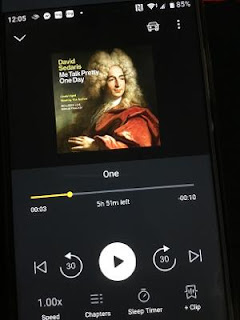
The collection of essays, Me Talk Pretty One Day by humorist David Sedaris, starts with a story of how in elementary school he was taken out of classes to attend speech therapy sessions. Rather than having his speech corrected, he worked around things by expanding his vocabulary to avoid the words with the “s” sounds he was deemed to be not good enough at. What follows are essays woven around the loose theme of talking/speech, presented in (from what I remember) chronological order, following his upbringing in North Carolina, his young adulthood in New York and his adulthood in New York and France. The tendency to choose different words as a workaround for speech problems continued into his adulthood. Rather than learn the genders of words in French, he would order things in multiples, since a “la” or “le” word transforms into a gender-neutral “les” when pluralized.

I found the book to be enjoyable, but largely forgettable. I was most interested in the stories about France, where he would give literal translations of things he tried to say in French and how the sentence structure was different and sounded juvenile in English. But the way he only presented the English end of the translations left me wanting to hear him say the thing again in French. When he talked about his first trip to France where one of the only words he knew was “bottleneck,” I longed for him to tell me the French word for “bottleneck.” Looking it up, Google Translate offers three different choices. Was he saying goulot? I’ll never know. And this is the kind of thing that really bothers me.

There were sections where I laughed, which is a pretty good endorsement, but sitting here today, I can’t tell you where those sections were or what they were about. I’ve forgotten them.

I didn’t actually read this book, I listened to it. It was read by the author. His voice, if you haven’t heard it, is similar to Droopy Dog from the old cartoons. A little southern, a little lispy, a little depressed. It was fine, really, but it drew attention to itself. For a book called Me Talk Pretty One Day, having the voice of the reader be another character in the stories works. A friend who adores David Sedaris was a little miffed that I told her my book report wasn’t going to be an overwhelming lovefest. She adores him and would listen to him saying just about anything. Sure, I feel this way about David Mitchell (the other one) and Richard Ayoade, but I do not share the passion for David Sedaris. I guess I need an English accent along with the whine to really enjoy it.

As far as the production goes, some of the chapters in the audiobook were recorded live in front of audiences and music was added in places, as chapter bumpers and during the live readings. I found this a little jarring.

Did I love it? No. Did I hate it? No. I’m sort of indifferent. If my friend said, “This other book is so much better. Listen to that one!” I would consider it. But I’m unlikely to seek out another of his books/essay collections on my own. It was whatever.


****

Anyway, I’ve finished my New Years Resolution of a book a month. Yay, me! What have I learned from this experience? I think I already knew it, but just reinforced that I actually hate reading, but I love books. Holding something with ideas inside, looking at the covers, smelling the pages…all great. Filling bookcases? Love it. Going to a bookstore? Love it. Finding a book with a cover drawn by Edward Gorey and adding it to my collection? Love it. But actually sitting and reading a book one of the worst things you can ask me to do. I guess that’s why it took me 10 years to edit my own novel. The idea of sitting down and having to read the thing was torture. Listening to books is better than reading them. But did I “enjoy” it? No. If I had, then the extra books I still have in my Audible library wouldn’t be sitting there, unlistened to. I actually finished this book in November and since then I’ve spent maybe another 30 minutes listening to a book. Knowing I was done and that I just had to write up the book report lifted a weight from my shoulders and no book has enticed me since then.

I’d like to blame my job for my disliking of reading. For work, I have to read a lot of screenplays. Sometimes I have to read a screenplay because of the continuity I’m writing and sometimes I’ll take work proofreading them. Reading = Work. For relaxation, I’m much more likely to put on a record. Listen to music. Practice piano or guitar. Write my own stuff. Do some crocheting or make some jewelry. Dig up weeds in the yard. Pull out my pastels and make some art. Sometimes I can put on an audiobook while I’m doing those other things, but just as often I’ll put on music. Or talk radio. Or a podcast. Or I’ll start the series of QI running at A and let it go. Background noise. A book isn’t background noise. It demands attention and mostly I don’t want to give it that attention.

Next year, my resolution will not involve books or reading.

Thursday, September 9, 2021

The Murder of Roger Ackroyd by Agatha Christie - September Book Report

 If there’s one thing I love, it’s a cozy mystery -- British preferred. I have seen every episode of Murder, She Wrote several times. I can watch Columbo episodes again and again. Agatha Raisin? Loved it. I’ve seen all of Poirot, Father Brown, Miss Fisher, Shakespeare & Hathaway, Rosemary & Thyme, Queens of Mystery and others. Not all of them work for me, but many do. So for my next book, I decided to not go for another memoir but to try a mystery novel instead.

The Murder of Roger Ackroyd is a Poirot story by Agatha Christie, published in 1926. I got the audiobook version, read by Hugh Fraser, who happens to play Captain Hastings on Poirot. He did a terrific job of reading/performing this story, including doing a good Poirot voice.

A couple of things stuck out to me in this novel. First, I must have read it before. Actually read it. I knew who the murderer was almost immediately. I’ve only read maybe three Agatha Christie novels, millions of years ago, so I thought it would be unlikely that I would select an audiobook of one of those that I’ve read, but that’s what happened.

If you’ve ever read any Agatha Christie, then you will know that guessing the murderer is nearly impossible. She withholds vital information until the very end, or introduces a new character at the very end. One of my favorite movies, Murder by Death, has a speech near the end about the frustration of reading stories by a writer like Christie. I found a copy of the speech online, which might not be accurate, but you get the point:

“You've tricked and fooled your readers for years. You've tortured us all with surprise endings that made no sense. You've introduced characters in the last five pages that were never in the book before. You've withheld clues and information that made it impossible for us to guess who did it. But now, the tables are turned. Millions of angry mystery readers are now getting their revenge. When the world learns I've outsmarted you, they'll be selling your $1.95 books for twelve cents.” -- Lionel Twain

That sums up my experience. So when I watch an episode of Poirot or Marple, I don’t try to figure out who did it. That is an impossible task. I just enjoy seeing the detective at work. Christie is a good writer and reading or listening to her work is enjoyable.

The second thing that stuck out to me was how easy her stories are to adapt to TVs and movies, which is probably why they remain so popular. The novel sounded almost like someone reading a screenplay. The dialogue was complete. The characters were complete. The locations were visual and the story was engaging.

I tried to find the TV version of this story, but for some reason it isn’t available on the subscription services I have, and I don’t want to pay extra just to watch it. Maybe I’ll change my mind, but for now that’s where I’m at.

Overall, this was a great title to listen to while pulling up crabgrass in my yard, and I’m leaving the door open to listening to more stories written by Agatha Christie.


Saturday, August 21, 2021

Gina Yashere: Cack-Handed: A Memoir - August (Audio) Book Report

The past few months I’ve been listening to a lot of the podcase RHLSP (Richard Herring’s Leicester Square Theater Podcast), where comedian Richard Herring interviews other (mainly British) comedians. Part of the appeal of that podcast is how terrible Richard Herring is at interviewing people. Another part of the appeal is that a lot of the episodes have video with them, not just audio, and can be watched on YouTube. A few of the interviews I’ve watched have been Stephen Fry, David Mitchell, David Baddiel, John Oliver, Alex Horne, Robert Webb. All men. All very successful in comedy. All graduates of Cambridge.

Looking at the list of Cambridge graduates you will also find Richard Ayoade, Jimmy Carr, John Cleese, Eric Idle, Peter Cook, Hugh Dennis, Simon Bird, Hugh Laurie, Mel Giedroyc, Sue Perkins, Ian McKellen, Emma Thompson, Sandi Toksvig, Olivia Colman and Sacha Baron Cohen. It seems like if you want to get into TV comedy in England, the fastest way to do it is by attending Cambridge and joining Footlights. Privilege and money seem like a shortcut to success.

After hearing so many of these identical stories, I was looking for something different. Didn’t anyone struggle? Didn’t anyone have to really claw their way up based only on their talent and not their luck? Sure, these people don’t have perfect lives, but not everyone starts at the same place. The Cambridge people started ahead and it isn’t too surprising they stayed ahead and will finish ahead.

Gina Yashere started behind. Her parents were from Nigeria and there was no free ride. As soon as she started working, in her mid-teens, she had to start giving part of her income to her mother (her father was gone by then) to help with the household expenses. Her mother hustled to keep the family together and to provide the best she could for her kids. And part of that meant her kids were going to be professionals.

Gina Yashere was slated to be the doctor in the family, but dissecting a frog ended that dream. She had to pass the doctor job onto a younger brother and became an engineer instead. But her heart wasn’t in it. A fortunate turn of events with work, leading to a few months of no work but with pay, allowed Gina to explore her creative side and that’s all it took for her to not go back to being an engineer.

Her memoir, Cack-Handed: A Memoir, tells the story of her life and how difficult it was to break into comedy in the UK. The racism and exclusion she experienced there led her to move to the USA where she has become a success with the TV series she writes and stars in, Bob ♥ Abishola.

But that’s the happy ending, where she is now. The book is about how she got there. An abusive step-father, a half-hearted suicide attempt, fights at school, moving around a lot, and being the outsider.

The chapter headings are all based on Nigerian sayings, and they are a delight. Here are a few:

A snake can only give birth to long things.
Going to church doesn’t make you a holy person any more than going to a garage makes you a mechanic.
If you sleep with an itching anus, you will definitely wake up with your hand smelling.
However hard a lizard does a push-up, it will never have an alligator’s chest.

It was a refreshing change to hear the story of someone normal, without the access and connections of a white man from a good family, who was able to make their dreams come true. Gina shows the outcomes that are possible through hard work, talent, determination and never questioning your own worth.

If you don’t know who Gina Yashere is, there are lots of clips of her on YouTube and as of this writing, two of her stand-up specials are available to stream on Netflix.


Wednesday, July 14, 2021

July Book Report - Susan Calman “Cheer Up Love: Adventures in Depression with the Crab of Hate”

 If you don’t know who Susan Calman is, then you must not watch a lot of British panel shows. She’s the very short Scottish comedian who started out as a lawyer. She can stand up inside of a red post box with no problem. She loves Doctor Who and names her cats after strong fictional female characters. And she seems like a happy person.

But looks can be deceiving. Cheer Up Love is a memoir which follows Susan’s (I feel like I can call her Susan since I know her so well from seeing her on tv) life story framed around her depression. It is a book about how she deals with depression and what she wishes people without depression understood about people with depression and how to interact with them. Hint: It doesn’t involve telling people with depression to “cheer up, love.”

As a person who has struggled with depression for as long as I could remember, there was a lot in Susan’s story I could relate to. For Susan, and for me, depression has been a lifelong companion. Susan has personified her depression into something she calls the crab of hate. The crab of hate visits Susan, but also goes away sometimes. And it isn’t something she can control. It is external to her. External to logic.

I listened to this as an audiobook, read by the author. It took me several chapters to get used to the way Susan reads. She doesn’t have the natural “acting” quality to her voice. You can definitely hear that she’s reading. But I don’t think the book could have been read or performed by anyone else.

I highly recommend Cheer Up Love to people who are depressed, looking for commiseration and maybe some tips on how to cope, and I recommend it to people aren’t depressed. Her portrayal of what it is like to actually be depressed can maybe help the non-depressed people of the world understand depression a little better. Or, if nothing else, provide them with a list of things which they should never say to a depressed person.


Tuesday, June 15, 2021

Back Story by David Mitchell (not that one) - June Book Report


I say “not that one” because most of the time when I would tell people what my June book was, they would say something like, “Oh, he’s a great writer.” Or “Cloud Atlas is great.” Or “That’s some pretty heavy reading for you, Camille.” No. Not that David Mitchell. The other one. The one who you might know from YouTube “David Mitchell Rants” compilation videos. Or, if you are like me, you’ll know from Peep Show, Would I Lie to You? and Upstart Crow. That David Mitchell. The funny one.

Once again, I did not read my June book. I listened to it. Read by David Mitchell himself.

I am a big fan of David Mitchell Rants videos. And of David Mitchell’s Soapbox. And of Would I Lie to You? I’ve seen all of Peep Show and Upstart Crow, but I’d hesitate to call myself a fan of those. I’ve seen the shows once, and that might keep me for the rest of my life. Not that I’d intentionally avoid seeing them again, I just don’t feel the need. But if new episodes do appear, I’ll watch them. How’s that? I can listen to David Mitchell ranting for hours, over and over again.

I bought Back Story (audiobook) several years ago when Audible convinced me that my life would be better with a subscription. One book credit a month for a low-low price of maybe $7.99 at the time? Fine. I have been known to spend over $4 on one glass of tea and to lose considerably more money on one impulsive trip to a casino. Potentially supporting some authors for such a low price seemed like a good idea. And then I never listened to any of the books. I found myself after several months with credits I hadn’t used. Audio files unpurchased. Those I had purchased were never started or even downloaded. I had listened to half of Colin Mochrie’s Not Quite the Classics (ready by the author) and got annoyed that my Amazon Dot thingy had such poor sound quality. I couldn’t hear the book and say, walk on the treadmill, or clean, or do dishes, or any of the other active things I wanted to do while listening to a book. That was why I was listening and not reading, so I could multitask. And Alexa just wasn’t doing her part.

Last month, Audible convinced me that even though the price they were now offering of $14.99/month wasn’t great, the two credits on offer for giving it some good considerations were. I downloaded Sabriel, for my May book which I hadn’t been able to bring myself to start actually reading, and then downloaded a copy of a friend’s book (The Resurrectionist by A.R. Meyering). I was reminded that I had a hidden little library of things just waiting for me. The technology for playing the audiobook was a little bit better suited to my lifestyle now. I could listen through my phone, which also meant I could listen in the car. I don’t drive a lot, but at least once a week I go on a 60-mile roundtrip and it was nice to have something beside the radio to listen to.

Back Story is sort of a mid-life autobiography. Usually, when I think of an autobiography, it is something that someone writes when they are nearing the end of things, looking back on a full life. Well, David Mitchell is perfectly happy to give you an update on how his life was by the year 2012, when he was just turning 38. FYI, we were born in the same year, but it is still a little frustrating to hear how far he had gotten by the time he was 38, now that I’m listening to the story from the ripe old age of 47.

The story of David’s life is hung on a framework of going for a daily walk through London. He talks about where he is now on the walk and then goes off on stories inspired by the things he sees and passes. “Oh, this pub reminds me of the time I got drunk in a pub at Cambridge,” etc. He manages to make a one hour walk around London into nearly 9.5 hours of reminiscing. This is not a complaint. The stories were interesting and there is no better way to hear them that having David Mitchell tell you himself. His writing is conversational, like he’s really there telling you these things. Although I fully know that the words were written and edited and critiqued before getting to me, they seem so natural that the experience of listening to the book feels almost like listening to a podcast or watching a series of extemporaneous rants on YouTube. In other words, a delight.

There are some people who are just naturally gifted at ranting, and David Mitchell is one of them. I’d like to throw a shoutout to a friend and former co-worker Shannon for also having this skill. Not that the book is all ranting. It’s stories. It’s life. It’s how success happens to one man who knew from a very young age what he wanted to do and to be.

If you are a fan of Olivia Coleman, keep an ear open for the time David Mitchell made her pee herself on stage. If you are a romantic, prepare to be swept away with David’s retelling of falling in love with his wife, Victoria (who is also well known in the UK and appears on many panel shows). If you want to know why David Mitchell doesn’t ever read anything by David Mitchell, the answers are provided.

I’m not familiar enough with London to fully visualized David’s walk, but I know a little bit. I feel like I’ve gotten to know David Mitchell a little bit after this book. And I think we would get along pretty well. He’s not as much of an upper-class snob as his TV personal plays up.

I enjoyed the experience of having this particular author read his own book to me and I’m considering downloading more of his books. Maybe I’ll download books by some other writer/comedians who I enjoy, like Richard Ayoade, so they can read to me, too. Just considering at this point, but who knows what tomorrow holds.


Monday, May 31, 2021

May Book Report - Sabriel by Garth Nix (with spoilers)


Lots of non-book-report stuff first:

 My birthday was in April and I was gifted some credit on Amazon. I didn’t have any idea what book to read in May. The only thing that I knew was, that despite reading a relatively short book in April, this has been a slog for me. I am not enjoying reading at all. One friend thought it had to do with book choice and tried to make suggestions of books I might like. She was annoyed by my request that the books all be under 300 pages or so, just so they weren’t daunting. The copy of The Moon Is a Harsh Mistress that I read was only 288 pages, but that was a trick. The current reprint edition is 398 pages long, and that 288 sure felt much longer. Tiny type will do that. I was miserable reading it. For many reasons.

 The friend who gave me the credits suggested Sabriel, based on what movies and stories he knows I enjoy. It was over my page limit, by a lot, at 491 pages, but he was basically giving it to me for my birthday because of the credit, and he thought I’d like it, so I gave it a try.

 I purchased the book very early in the month. It arrived much faster than the books I’ve been buying from independent sellers (and England) so far, so I had it available for almost the entire month. And there it sat.

 I’d like to say that I was too busy with work to get to reading, but I went almost three weeks without work in May. I freelance, so I never know how things will be with work. For June, I’m booked and will probably also be working weekends to get everything done on time and with enough attention devoted to it. But May was wide open. Day after day, I’d look at the book, see how thick it was, and put on YouTube, listen to a podcast or go for a walk in the garden.

 One night, I searched for Sabriel on YouTube and found a man who was doing his own audiobook reading of it. I listened to chapter one. It wasn’t that bad (the story or the reading of it), but I still didn’t want to crack open the book. So I listened to chapter two. He has recorded the first nine chapters, and I listened to them. Then I learned there was a prologue in the book, so I listened to that after chapter nine.

 But there were only nine chapters available this way. I got out the book, flipped to the start chapter ten and put in the bookmark…

 Then I got an email from Audible that they wanted to give me two free audiobooks. Ding! Winner! And so I listened to Sabriel, starting at chapter ten, read by Tim Curry.

 Now some book report stuff:

 Sabriel is a young woman, 16 or 17, who grew up in a very earth-like place called Ancelstierre which is separated by a wall from the Old Kingdom, where magic exists. Her father remained in the Old Kingdom because his bloodline as something called an Abhorsen meant he was needed to stop, or help stop, the constant stream of dead people and things which would claw their way back to life. He was a necromancer and was able to send the dead things back into death, by traveling there himself and taking them. He could also travel into death and bring back the spirits of things which were newly dead and make them not dead if their bodies were in good condition.

 Death in the Old Kingdom is a place with a series of areas with water connecting them. They are divided by gates and it is only when a dead thing passes the ninth and final gate that it can’t come back to life. An ancient evil being, Kerrigor, is trying to amass an army of dead things to destroy the controlled magic in the Old Kingdom, called Charter magic, and replace it with free magic. I guess because the free magic is more powerful? I missed some of that.

 Anyway, Abhorsen goes missing, not making one of his regularly scheduled meetings with Sabriel and instead sending a dead messenger to her with the tools of the necromancer - a sword and a set of magical bells. Sabriel decides to journey to the Old Kingdom to find him. It becomes her job to fight Kerrigor and restore order to the Old Kingdom, becoming the new Abhorsen.

 The story was enjoyable enough. There is a cat, called Mogget, who isn’t all he appears. He works as a servant to the Abhorson and joins Sabriel on the quest to find her father and destroy Kerrigor. She also rescues the future king, who has been turned to wood for 200, and he joins her on the quest.

 Things which really stuck out to me from the listening were that the words “Charter magic” and “Charter stones” are said a lot.  A lot-a lot. I also didn’t love the way Tim Curry did the character voices. Mogget was smarmy and everyone else sounded annoyed and snitty most of the time. But I enjoyed his reading of the bulk of the book, and that he read it so I didn’t have to.

 My main complaint at the end when (SPOILER!!!) Kerrigor is turned into a cat like Mogget is that the reader doesn’t find out what happens to cat Kerrigor. I read a little bit about the next books in the series and it seems like Kerrigor is not mentioned again. Oh, well. The thing which really got me through the story was Mogget being a cat. There were some nice visual elements in the story, like the Paperwing, a paper plane which kind of magically becomes life-like and bird-like when a mage whistles and controls it. The moments of peril didn’t last very long, which I also like because I don’t want to have to stress about what fictional characters are doing.

 By listening to the story instead of reading it, there were things which I felt were glossed over a little quickly - like what exactly Mogget is. If I had read it, I probably would have reread the few sentences where he is explained so that I was sure I understood it. I didn’t bother to go relisten to anything, aside from one time when I was getting a lot of text messages which were really disruptive to my concentration. When I read something, I’ll often reread passages just to make sure I’ve really understood everything.

 Sabriel would make a good movie, probably animated, or mini-series. I’d be curious to see and hear the bells. I enjoyed it, but not enough to continue with the series.