Showing posts with label listening. Show all posts

Tuesday, December 21, 2021

December Book Report and Some Thoughts on the Year: Me Talk Pretty One Day by David Sedaris


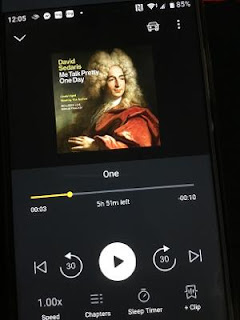
The collection of essays, Me Talk Pretty One Day by humorist David Sedaris, starts with a story of how in elementary school he was taken out of classes to attend speech therapy sessions. Rather than having his speech corrected, he worked around things by expanding his vocabulary to avoid the words with the “s” sounds he was deemed to be not good enough at. What follows are essays woven around the loose theme of talking/speech, presented in (from what I remember) chronological order, following his upbringing in North Carolina, his young adulthood in New York and his adulthood in New York and France. The tendency to choose different words as a workaround for speech problems continued into his adulthood. Rather than learn the genders of words in French, he would order things in multiples, since a “la” or “le” word transforms into a gender-neutral “les” when pluralized.

I found the book to be enjoyable, but largely forgettable. I was most interested in the stories about France, where he would give literal translations of things he tried to say in French and how the sentence structure was different and sounded juvenile in English. But the way he only presented the English end of the translations left me wanting to hear him say the thing again in French. When he talked about his first trip to France where one of the only words he knew was “bottleneck,” I longed for him to tell me the French word for “bottleneck.” Looking it up, Google Translate offers three different choices. Was he saying goulot? I’ll never know. And this is the kind of thing that really bothers me.

There were sections where I laughed, which is a pretty good endorsement, but sitting here today, I can’t tell you where those sections were or what they were about. I’ve forgotten them.

I didn’t actually read this book, I listened to it. It was read by the author. His voice, if you haven’t heard it, is similar to Droopy Dog from the old cartoons. A little southern, a little lispy, a little depressed. It was fine, really, but it drew attention to itself. For a book called Me Talk Pretty One Day, having the voice of the reader be another character in the stories works. A friend who adores David Sedaris was a little miffed that I told her my book report wasn’t going to be an overwhelming lovefest. She adores him and would listen to him saying just about anything. Sure, I feel this way about David Mitchell (the other one) and Richard Ayoade, but I do not share the passion for David Sedaris. I guess I need an English accent along with the whine to really enjoy it.

As far as the production goes, some of the chapters in the audiobook were recorded live in front of audiences and music was added in places, as chapter bumpers and during the live readings. I found this a little jarring.

Did I love it? No. Did I hate it? No. I’m sort of indifferent. If my friend said, “This other book is so much better. Listen to that one!” I would consider it. But I’m unlikely to seek out another of his books/essay collections on my own. It was whatever.


****

Anyway, I’ve finished my New Years Resolution of a book a month. Yay, me! What have I learned from this experience? I think I already knew it, but just reinforced that I actually hate reading, but I love books. Holding something with ideas inside, looking at the covers, smelling the pages…all great. Filling bookcases? Love it. Going to a bookstore? Love it. Finding a book with a cover drawn by Edward Gorey and adding it to my collection? Love it. But actually sitting and reading a book one of the worst things you can ask me to do. I guess that’s why it took me 10 years to edit my own novel. The idea of sitting down and having to read the thing was torture. Listening to books is better than reading them. But did I “enjoy” it? No. If I had, then the extra books I still have in my Audible library wouldn’t be sitting there, unlistened to. I actually finished this book in November and since then I’ve spent maybe another 30 minutes listening to a book. Knowing I was done and that I just had to write up the book report lifted a weight from my shoulders and no book has enticed me since then.

I’d like to blame my job for my disliking of reading. For work, I have to read a lot of screenplays. Sometimes I have to read a screenplay because of the continuity I’m writing and sometimes I’ll take work proofreading them. Reading = Work. For relaxation, I’m much more likely to put on a record. Listen to music. Practice piano or guitar. Write my own stuff. Do some crocheting or make some jewelry. Dig up weeds in the yard. Pull out my pastels and make some art. Sometimes I can put on an audiobook while I’m doing those other things, but just as often I’ll put on music. Or talk radio. Or a podcast. Or I’ll start the series of QI running at A and let it go. Background noise. A book isn’t background noise. It demands attention and mostly I don’t want to give it that attention.

Next year, my resolution will not involve books or reading.

Wednesday, October 6, 2021

October Book Report - The Cat Who Knew a Cardinal by Lilian Jackson Braun


Since I enjoy a good mystery, I decided to try out one of the “cat who” series books by Lilian Jackson Braun. I had no idea how to select a “good” book from the series, so I just picked one that had a good rating on Audible.

The Cat Who Knew a Cardinal was published in 1991, something I didn’t realize until just now. The first “cat who” book was published in 1966 and the one I read was the 12th in the series. There was a big gap between the first three novels and the next, from 1968 to 1986. For some reason, probably because I’ve spent so much time with Agatha Christie in the past two months, as I listened to this book I imagined it was set in a much more distant past than the 1990s. The setting of a small town helped with that illusion. I don’t recall there being any talk of computers or mobile phones. The internet wasn’t really a thing yet and mobile phones didn’t really become a regular thing until the late 1990s. As a result, it didn’t matter that I pictured the story being in “the past,” like anywhere between 1950 and 1970.

I don’t know what I expected of the titular cat, but I was a little disappointed in the cats and their involvement in the crime solving. I know cats can’t solve crime, but the little hype I had heard about these novels led me to believe the cats would be more integral.

Once again, I listened to this story and didn’t read it. It was read to me by George Guidall. I did not enjoy his narration. The lead character in the story, Qwill, is a man. The reading for the men in the story was fine. It was each time the narrator had to voice a woman that I would drop out of the story. He voiced all the women as snippy and short, and I can’t believe they would all have been written that way.

By this time in the continuing story of Qwill, he has two cats, not just one. The original cat Koko is still with him, but now has a companion Yum Yum. The story reminded me in many ways of Murder, She Wrote. It is set in a small town and the focus is just as much on the quirky cast of characters as it is on the murder which has taken place. Perhaps after reading several books I might be more invested in the characters, but with just one I didn’t find them all that likeable.

It isn’t even worth talking too much about the plot, which was fine but not compelling. I’m not saying to avoid the series, but this one wasn’t that great and certainly not the best introduction to the series. I don’t think all of the titles were available on Audible, which limited my options when picking which one to listen to. And some of the comments indicated that on the 2 for 1 offers on Audible the books were abridged versions, which I didn’t want.

Anyway, another one done and two more to go for my year of books!


Saturday, August 21, 2021

Gina Yashere: Cack-Handed: A Memoir - August (Audio) Book Report

The past few months I’ve been listening to a lot of the podcase RHLSP (Richard Herring’s Leicester Square Theater Podcast), where comedian Richard Herring interviews other (mainly British) comedians. Part of the appeal of that podcast is how terrible Richard Herring is at interviewing people. Another part of the appeal is that a lot of the episodes have video with them, not just audio, and can be watched on YouTube. A few of the interviews I’ve watched have been Stephen Fry, David Mitchell, David Baddiel, John Oliver, Alex Horne, Robert Webb. All men. All very successful in comedy. All graduates of Cambridge.

Looking at the list of Cambridge graduates you will also find Richard Ayoade, Jimmy Carr, John Cleese, Eric Idle, Peter Cook, Hugh Dennis, Simon Bird, Hugh Laurie, Mel Giedroyc, Sue Perkins, Ian McKellen, Emma Thompson, Sandi Toksvig, Olivia Colman and Sacha Baron Cohen. It seems like if you want to get into TV comedy in England, the fastest way to do it is by attending Cambridge and joining Footlights. Privilege and money seem like a shortcut to success.

After hearing so many of these identical stories, I was looking for something different. Didn’t anyone struggle? Didn’t anyone have to really claw their way up based only on their talent and not their luck? Sure, these people don’t have perfect lives, but not everyone starts at the same place. The Cambridge people started ahead and it isn’t too surprising they stayed ahead and will finish ahead.

Gina Yashere started behind. Her parents were from Nigeria and there was no free ride. As soon as she started working, in her mid-teens, she had to start giving part of her income to her mother (her father was gone by then) to help with the household expenses. Her mother hustled to keep the family together and to provide the best she could for her kids. And part of that meant her kids were going to be professionals.

Gina Yashere was slated to be the doctor in the family, but dissecting a frog ended that dream. She had to pass the doctor job onto a younger brother and became an engineer instead. But her heart wasn’t in it. A fortunate turn of events with work, leading to a few months of no work but with pay, allowed Gina to explore her creative side and that’s all it took for her to not go back to being an engineer.

Her memoir, Cack-Handed: A Memoir, tells the story of her life and how difficult it was to break into comedy in the UK. The racism and exclusion she experienced there led her to move to the USA where she has become a success with the TV series she writes and stars in, Bob ♥ Abishola.

But that’s the happy ending, where she is now. The book is about how she got there. An abusive step-father, a half-hearted suicide attempt, fights at school, moving around a lot, and being the outsider.

The chapter headings are all based on Nigerian sayings, and they are a delight. Here are a few:

A snake can only give birth to long things.
Going to church doesn’t make you a holy person any more than going to a garage makes you a mechanic.
If you sleep with an itching anus, you will definitely wake up with your hand smelling.
However hard a lizard does a push-up, it will never have an alligator’s chest.

It was a refreshing change to hear the story of someone normal, without the access and connections of a white man from a good family, who was able to make their dreams come true. Gina shows the outcomes that are possible through hard work, talent, determination and never questioning your own worth.

If you don’t know who Gina Yashere is, there are lots of clips of her on YouTube and as of this writing, two of her stand-up specials are available to stream on Netflix.