Showing posts with label book. Show all posts

Thursday, September 9, 2021

The Murder of Roger Ackroyd by Agatha Christie - September Book Report

 If there’s one thing I love, it’s a cozy mystery -- British preferred. I have seen every episode of Murder, She Wrote several times. I can watch Columbo episodes again and again. Agatha Raisin? Loved it. I’ve seen all of Poirot, Father Brown, Miss Fisher, Shakespeare & Hathaway, Rosemary & Thyme, Queens of Mystery and others. Not all of them work for me, but many do. So for my next book, I decided to not go for another memoir but to try a mystery novel instead.

The Murder of Roger Ackroyd is a Poirot story by Agatha Christie, published in 1926. I got the audiobook version, read by Hugh Fraser, who happens to play Captain Hastings on Poirot. He did a terrific job of reading/performing this story, including doing a good Poirot voice.

A couple of things stuck out to me in this novel. First, I must have read it before. Actually read it. I knew who the murderer was almost immediately. I’ve only read maybe three Agatha Christie novels, millions of years ago, so I thought it would be unlikely that I would select an audiobook of one of those that I’ve read, but that’s what happened.

If you’ve ever read any Agatha Christie, then you will know that guessing the murderer is nearly impossible. She withholds vital information until the very end, or introduces a new character at the very end. One of my favorite movies, Murder by Death, has a speech near the end about the frustration of reading stories by a writer like Christie. I found a copy of the speech online, which might not be accurate, but you get the point:

“You've tricked and fooled your readers for years. You've tortured us all with surprise endings that made no sense. You've introduced characters in the last five pages that were never in the book before. You've withheld clues and information that made it impossible for us to guess who did it. But now, the tables are turned. Millions of angry mystery readers are now getting their revenge. When the world learns I've outsmarted you, they'll be selling your $1.95 books for twelve cents.” -- Lionel Twain

That sums up my experience. So when I watch an episode of Poirot or Marple, I don’t try to figure out who did it. That is an impossible task. I just enjoy seeing the detective at work. Christie is a good writer and reading or listening to her work is enjoyable.

The second thing that stuck out to me was how easy her stories are to adapt to TVs and movies, which is probably why they remain so popular. The novel sounded almost like someone reading a screenplay. The dialogue was complete. The characters were complete. The locations were visual and the story was engaging.

I tried to find the TV version of this story, but for some reason it isn’t available on the subscription services I have, and I don’t want to pay extra just to watch it. Maybe I’ll change my mind, but for now that’s where I’m at.

Overall, this was a great title to listen to while pulling up crabgrass in my yard, and I’m leaving the door open to listening to more stories written by Agatha Christie.


Saturday, August 21, 2021

Gina Yashere: Cack-Handed: A Memoir - August (Audio) Book Report

The past few months I’ve been listening to a lot of the podcase RHLSP (Richard Herring’s Leicester Square Theater Podcast), where comedian Richard Herring interviews other (mainly British) comedians. Part of the appeal of that podcast is how terrible Richard Herring is at interviewing people. Another part of the appeal is that a lot of the episodes have video with them, not just audio, and can be watched on YouTube. A few of the interviews I’ve watched have been Stephen Fry, David Mitchell, David Baddiel, John Oliver, Alex Horne, Robert Webb. All men. All very successful in comedy. All graduates of Cambridge.

Looking at the list of Cambridge graduates you will also find Richard Ayoade, Jimmy Carr, John Cleese, Eric Idle, Peter Cook, Hugh Dennis, Simon Bird, Hugh Laurie, Mel Giedroyc, Sue Perkins, Ian McKellen, Emma Thompson, Sandi Toksvig, Olivia Colman and Sacha Baron Cohen. It seems like if you want to get into TV comedy in England, the fastest way to do it is by attending Cambridge and joining Footlights. Privilege and money seem like a shortcut to success.

After hearing so many of these identical stories, I was looking for something different. Didn’t anyone struggle? Didn’t anyone have to really claw their way up based only on their talent and not their luck? Sure, these people don’t have perfect lives, but not everyone starts at the same place. The Cambridge people started ahead and it isn’t too surprising they stayed ahead and will finish ahead.

Gina Yashere started behind. Her parents were from Nigeria and there was no free ride. As soon as she started working, in her mid-teens, she had to start giving part of her income to her mother (her father was gone by then) to help with the household expenses. Her mother hustled to keep the family together and to provide the best she could for her kids. And part of that meant her kids were going to be professionals.

Gina Yashere was slated to be the doctor in the family, but dissecting a frog ended that dream. She had to pass the doctor job onto a younger brother and became an engineer instead. But her heart wasn’t in it. A fortunate turn of events with work, leading to a few months of no work but with pay, allowed Gina to explore her creative side and that’s all it took for her to not go back to being an engineer.

Her memoir, Cack-Handed: A Memoir, tells the story of her life and how difficult it was to break into comedy in the UK. The racism and exclusion she experienced there led her to move to the USA where she has become a success with the TV series she writes and stars in, Bob Abishola.

But that’s the happy ending, where she is now. The book is about how she got there. An abusive step-father, a half-hearted suicide attempt, fights at school, moving around a lot, and being the outsider.

The chapter headings are all based on Nigerian sayings, and they are a delight. Here are a few:

A snake can only give birth to long things.
Going to church doesn’t make you a holy person any more than going to a garage makes you a mechanic.
If you sleep with an itching anus, you will definitely wake up with your hand smelling.
However hard a lizard does a push-up, it will never have an alligator’s chest.

It was a refreshing change to hear the story of someone normal, without the access and connections of a white man from a good family, who was able to make their dreams come true. Gina shows the outcomes that are possible through hard work, talent, determination and never questioning your own worth.

If you don’t know who Gina Yashere is, there are lots of clips of her on YouTube and as of this writing, two of her stand-up specials are available to stream on Netflix.


Tuesday, March 30, 2021

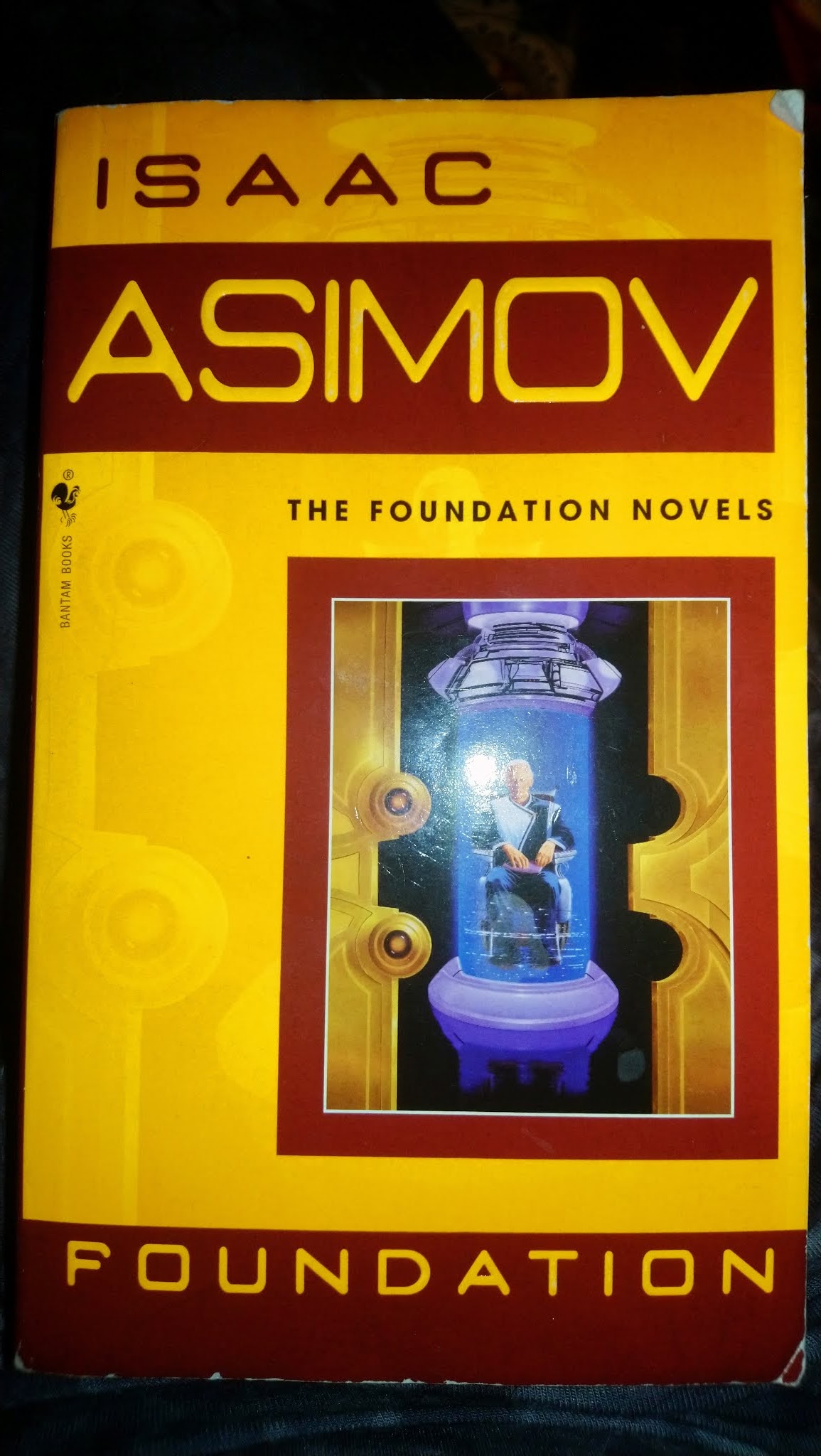
Book Report - Foundation by Isaac Asimov

It is the future. People have spread out all across the universe and the Galactic Empire rules. No, this is not Star Wars. That’s set in the past.

 In the future, a science has developed which is akin to fortune telling. One man, Hari Seldon, is an expert in this science and he has seen the end of the Empire. He sets in motion an elaborate, century-spanning plan to build a better ruling outcome for the universe, hopefully sparing centuries of war and unrest in the process. The start of his plan it to be exiled to the farthest end of the universe with a group of intellectuals, under the pretense of writing the perfect, all-encompassing encyclopedia of everything ever. And to not tell them the rest of the plan. Hari Seldon has recorded holograms of himself which play at pre-determined times, when he has predicted a great conflict or crisis will have just been overcome. They provide the only clue if his vision of the future is happening as he predicted or not. (It is.)

 The whole book is like a game a chess. You know how in chess, before you make your move, you try to calculate all the other moves your opponent could make as a result? Yes. Boring and time consuming. And when done properly, not very surprising. (I’m not very good and chess and never really understood why it was fun. I have not watched the Queen’s Gambit yet.)

 Let me get this out of they way. I counted two female characters in the whole book. A secretary who got one or two lines of mention, and a Commdora. The Commdora got two whole scenes, maybe totaling four pages, but she was just there to be snippy. The rest of the time, any new character who gets introduced - no matter how unfamiliar their name - don’t worry! It’s a man.

 The story is told primarily through dialogue, which makes it not very interesting and difficult to follow at times. At the start of each chapter, a paragraph or two of set-up is presented and then the characters chat. And at the start of each section of the book (there are four), just go ahead and forget all the characters you were just getting to know. They are long dead and it is now dozens of years later. But don’t forget them completely. Their names might come up. But while you try to remember the names of characters who have disappeared and died, also learn the names of all the new characters in the new section of the novel. Names, names, names.

 None of the characters are fully developed. The action, predicted, but kept secret, by Hari Seldon, is not exciting. Things just work out. Wars don’t happen. And if it looks like a war is about to happen, turn the page and it is fifty years later and the first sentence makes it clear the war was, in fact, avoided. The story is all lining up dominoes, but the reader never gets the satisfaction of seeing them knocked down.

 It does have some interesting parallels to modern-day politics. Part of one successful war-avoiding tactic is to build a religion. They use missionaries to infiltrate surrounding worlds, or train priests on those worlds, and ultimately disable power supplies. It is hard to read how the religion is weaponized in Foundation and not see similarities to how Evangelical Christians and Republicans currently work together to push an agenda. It works until the missionaries and priests are no longer welcome on nearby worlds, because they have been revealed to be more loyal to their religion than anything else.

 If putting plans in motion, politics, discussions and a universe where women are virtually nonexistent sounds good to you, then you might like Foundation. It didn’t work for me.


Thursday, March 18, 2021

Do Androids Dream of Electric Sheep? By Philip K. Dick - Book Report

 In the near future, which ironically already happened, January 3, 2021, the world is a different place thanks to World War Terminus. Not a lot of details are given about the war, but it becomes clear that most life, not just human life, has been wiped out on Earth. Most people have left Earth and live on one of the colony planets, where androids (which are nearly indistinguishable from people) are used as slaves.

If you remained on Earth, you would be lucky if you aren’t affected by the radiation which has poisoned everything. Most people start to deteriorate mentally after too much exposure, and then become ineligible to travel to a colony. But some people just don’t want to go. Like the hero of the story, Rick Deckard.

The androids from the colonies are sentient enough to realize they are slaves, and to want better lives. Because of this, many of them travel to Earth illegally and attempt to blend in with the people. Rick’s job is to hunt these androids and kill them.

When he gets an assignment to hunt down the most advanced version of androids yet, he jumps at the opportunity. An opportunity he only gets because the original (better) bounty hunter has been hospitalized from his encounter with one of these androids. Rick desperately wants the extra money because owning a pet on Earth is now a status symbol, since most animals are dead. And Rick and his wife, Iran, didn’t manage to keep their pet sheep alive and have replaced it with an electric one. If the neighbors found out they were keeping an electric sheep, they would be humiliated. With the extra income from these bounties, Rick hopes to buy an ostrich, despite the exorbitant cost of $30,000.00.

Meanwhile, a man named J. R. Isidore lives outside of the city in the wastelands. The suburbs of the city are filled with abandoned buildings from the mass exodus of people from Earth. Isidore’s brain has started to decay. He lives alone in a high-rise apartment building and doesn’t have a pet. He works undercover for an electronic pet repair shop which is disguised as veterinary services, picking up malfunctioning animals. Unfortunately, he does pick up a real cat and mistakes it for a fake one, hastening its death. He becomes a refuge for one of the escaped androids, Pris, who moves into his building and eventually brings two other androids along.

Rick’s hunt brings him out into the country, crossing paths with Isidore. They each also have weird religious experiences with the Christ-like figure Mercer. Mercer seems to have been created to provide humans with one of the things the androids are incapable of - empathy. But it isn’t entirely clear if Rick’s and Isadore’s experiences with Mercer are real or imagined. Is Mercer real? Is he an actor? Is he an android?

The writing is brisk to the point of feeling like details are missing. I’m so used to fight scenes (in movies) being drawn out, lasting far too long for the people fighting to still be standing, that it was jarring to read a fight scene which started and concluded in just a couple of sentences. I had to go back and read a few paragraphs a second time to make sure I wasn’t missing something. I wasn’t. There wasn’t more. Like if someone was shot in the head, they were shot in the head and dead and the story moved on to the next thing immediately.

For serious animal lovers, you might want to stay away from this one. There aren’t many animals in it, and yet most of them do not have pleasant ends. The androids embody all of humanity’s negative aspects (greed, jealousy, anger and hostility) but they don’t have any of humanity’s positive emotions (empathy, love), so they don’t value life, human or animal, the same way as the humans remaining on Earth do.

Do Androids Dream of Electric Sheep is a short, easy read. If you are looking for Blade Runner, you don’t get much of it here. Although it’s been a long time since I’ve seen Blade Runner, I don’t remember many of the main elements of the novel in the film. Was Rick married? Did he have an electronic pet sheep? Did he want to buy an ostrich and eventually buy a goat? Did Pris look identical to the other android Rachael because they were the same model? Did Rachael fully know she was an android? I don’t think any of these things were included in the movie. And I don’t think the whole religious, Sisyphus and Christ-like Mercer was in the movie at all.

I wasn’t reading it expecting it to be Blade Runner. I was reading it to read it. But it is impossible to read it and not compare it to the movie as you go along. If you are looking for Blade Runner, or if you love lush prose, then you should skip this one. But if you are curious, then I would recommend reading it.

Wednesday, March 3, 2021

The Moon Is a Harsh Mistress - Book Report

 My New Year’s resolution this year is to read one book a month. I know for many of you this is easy and not worth a resolution. I read a lot of screenplays each year and work by writing, so more text isn’t actually that relaxing for me. So since I’m going through this hard work, I decided to do book reports. This is my February book. I'll go back and do January's report soon.  


Designed to be a prison camp, the colonies on the moon have evolved into something bigger. The tunnels of the moon are used for farming and because of favorable gravity, shipments of grain are sent from the moon to the earth to feed overpopulated cities. It isn’t only prisoners on the moon now, though. Spouses and children of prisoners were allowed to go with them. And after a hundred years of sending people to the moon, many of the residents were born free, but as citizens of the moon. Everything there is controlled by the prison guards and the company they work for, Lunar Authority, though.

One supercomputer controls almost all operations on the moon, on Luna. A Holmes computer, which because of regular expansion of its memory and processors, has become sentient. The only person who has noticed the computer is “alive” is a Luna-born computer technician named Mannie, or Man, who is sent to repair the computer whenever it malfunctions. Man has named the computer Mike, short for Mycroft Holmes, Sherlock’s older brother. The computer malfunctions are usually Mike trying to be funny and not actual errors.

Perhaps manipulated by Mike, Man is thrown into the world of Luna’s underground rebellion. The citizens of Luna want to be free. With the help of two revolutionaries, Wyoming Knott (Wyoh) and Professor de la Paz (Prof), Man and Mike join the fight and help sway the odds in favor of the Lunatics in the fight for their lives and livelihoods. Mike eventually develops many different personalities, but they are of little consequence. They can all be thought of as Mike.

It sounds great. But this is one difficult book to read. The story is told from Man’s point of view, maybe as many as 60 years after the fact. And because Man was raised by people exiled from Russia, he speaks in the way one imagines a stereotypical Russian to speak. Here’s a sample sentence from the book:

Was comfortable lounge with own bath and no water limit.

It would be easier to read with more words:

There was a comfortable lounge with its own bath and no limit to water use.

Maybe no the optimum example from the novel, but the first one I found opening it up. The whole thing benefits from having the voice in your head speak in a Russian accent. I don’t think I could have gotten through it without hearing the text in a Russian accent. And there are Russian words scattered around here and there, just to drive home the point.

The author also gets really hung up in explaining relatively unimportant ideas in relation to the overall plot. Because the population on Luna is 2:1 male to female, most people live in clans with polygamist beliefs. Man has many “wives” and “husbands,” who live together, raise children together, and work on their farm together. The explanation of how this all works out is tedious and I will admit, I don’t think I read every single word about it.

Similarly, I glazed over a bit when the description of how the information cells in the rebellion were structured. Mike on top, with a pseudonym starting with A (Adam Selene), Man, Wyoh and Prof below, with pseudonyms starting in B, each controlling a cell of 3 with pseudonyms starting in C and so on. I think this went on for pages! And look, I’ve covered the basics in one sentence. If you encountered someone whose pseudonym started in F, you would know he was in the sixth level, and exponentially you could figure out there would be 243 people on level F.

 Some things in the description didn’t match with how I pictured the story in my mind. The cities on the moon are all underground, but when they are first introduced my mind drew them as more enclosed in domes, built on multiple levels, not necessarily underground. And as some point I think Man is described as wearing tights and having a bare chest. The farmer and computer technician of Man (who has one artificial arm) looked more like a farmer or computer technician, in coveralls or a boiler suit, in my head. I had trouble picturing him as bare chested. I also had trouble picturing a 40-year-old man as 20, because aging on the moon is very kind. Lunatics live into their hundreds regularly, and because the colonization of the moon isn’t very old, no one is really sure what the average life-expectancy on the moon might be. I pictured Man as a one-armed Jason Statham in a boiler suit with a thick Russian accent. Wyoh? Gwendoline Christie. Prof? Antonio Banderas.

It was interesting that Luna had a strict code of ethics, which needed little to no police supervision. If you got out of line with someone, murder is extremely easy on the moon. And it is already a prison. As a result, people behave and are courteous. And because women are so outnumbered, they are treated with greater respect (although whistled at constantly and written to enjoy it). The kick-off of the revolution actually happening, after years of planning, is when the prison guards rape a woman, violating one of the most sacred codes on Luna.

Overall, I do think this would be a good adaptation for a mini-series. Too much going on for a movie. But I don’t recommend that anyone read the actual book.

The Moon is a Harsh Mistress by Robert A. Heinlein, © 1966


Somehow I got a UK copy of the book, although I didn't notice any spelling issues aside from all the Russian.


And I should mention that TANSTAAFL (There Ain't No Such Thing as a Free Lunch) is the slogan of the moon, and mentioned with some frequency in the book. But that's a different book report.